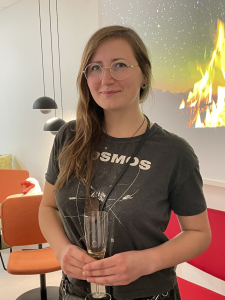
New article published

A new paper from the lab has been published in Chemical Senses today. Free odor identification engages domain-general cognitive abilities in old adults, by Thomas Hörberg, Rohan Raj and Jonas Olofsson (et. al.) and investigates odor identification and cognitive aging.

Find it here: https://doi.org/10.1093/chemse/bjaf049


Two new grants awarded from Riksbankens Jubileumsfond

Today Riksbankens Jubileumsfond released accepted applications for their project grants. Both Malina Szychowska’s and Thomas Hörberg’s applications were accepted and will receive funding for the next three years.

Malina Szychowska for the project: Sensory competition in spatial memory.

Thomas Hörberg for the project: Building a cross-cultural semantic framework for odor vocabularies.

Thomas Hörberg

Malina Szychowska

Opinion Piece in Dagens Nyheter

On Sunday, Jonas Olofsson and Håkan Fischer, professors of Psychology at Stockholm University, published an opinion article in the leading Swedish newspaper Dagens Nyheter. They warn about the risks of the one-sided focus on natural sciences, technology and medicine in the Swedish government research strategy. They recommend harnessing insights from psychology, social sciences and humanities so that technological developments may have a positive and sustainable social impact.

https://www.dn.se/debatt/utan-manniskan-blir-forskningen-bara-platt/ (Swedish)

Dr Stephen Pierzchajlo successfully defended his thesis

Our now former PhD Candidate Stephen Pierzchajlo successfully defended his dissertation Smelling Without A Smell: How olfactory-perceptual representations are activated by words.

Abstract:

We spend every day using our senses to interact with the world. Though we use language as a way to understand the sensory world, language might have different roles for different senses. Freely identifying odors in naming tasks is more difficult than with senses like vision, making olfaction an interesting place to study the intersection between language and the senses. While free olfactory identification is poor, word cues strongly increase our ability to identify odors. This has led some to conclude that olfaction is more dependent on supporting information from other senses, and that odors are encoded in a coarse way, so it is particularly dependent on language and sensory cues to function capably. This has further led to debate regarding whether language can activate olfactory-related representations in the brain, or whether odor and language systems are disconnected. The general aim of this thesis was to investigate whether and how word cues can affect olfactory processes and representations.

You can find the dissertation here: https://su.diva-portal.org/
SweCog conference 2025

This week SCI-Lab is attending the SweCog conference (7-9/10) in Lund.

https://konferens.ht.lu.se/swecog-2025/.

We will contribute 3 oral presentations, 1 poster presentation and 8 lab-members in attendance. We are looking forward to a great couple of days of interesting cognitive research and discussions!